
Montcalm Projected Versus Actual Release
A projected date is a calculation or legal milestone based on the record as it stands. It is not proof that a person walked out of a jail or prison on that day. For an MDOC prisoner, the public record may show when the Parole Board first has jurisdiction, the maximum potential end of MDOC authority, the actual day parole began, or the final date of discharge. Each label answers a different question.
Scheduled versus actual: An Earliest Release Date marks potential parole eligibility; Date Paroled records an actual prison departure to parole, and Discharge Date marks the end of MDOC jurisdiction.
Montcalm County Jail cases need a separate reading. A pretrial detainee has no fixed sentence-completion date because the court has not imposed a sentence. A person serving a local sentence may have a date calculated from the judgment, jail credit, later orders, and any holds. Call the jail or obtain the maintained record. Do not apply a state-prison OTIS date to a county-jail-only stay.
Physical departure also differs from legal authority. A court order may authorize release, yet processing or another custodian’s hold may prevent community release. Conversely, leaving one facility through a transfer does not end custody. The correct record must identify both the custodian and the kind of event.
Find Montcalm County Projected Dates
Start with the system that holds the person. Carson City Correctional Facility is an MDOC state prison, so OTIS is the first public source. Montcalm County Jail is a county facility, so the jail, the sentencing court, and a county record request are the useful routes. The Montcalm County release-record search paths help when the custodian is not yet clear.
- Identify whether the person is held before trial, serving a Montcalm County sentence, or serving an MDOC prison term.
- For MDOC custody, search OTIS by MDOC number when known. Otherwise use a last name and enough details to avoid a false match.
- Open the matching profile and read Current Status, Assigned Location, Earliest Release Date, and Maximum Discharge Date.
- If the record says Parolee, read Date Paroled and the assigned supervision location. If it says Discharged, read the Discharge Date and reason.
- For Montcalm County Jail, call 989-831-7592 and check the judgment or later order in the proper local court.
- When a durable calculation is needed, request the existing jail release record, court order, or MDOC time-computation record from its custodian.
The Montcalm County Jail Services page is the official local status-line source. It notes that court-driven status may not be known until later in the day and suggests trying again after 3 p.m. on weekdays when an update is not yet available. That is a court-update clue, not a promised release hour.
OTIS Montcalm Release Date Labels
OTIS means Michigan Offender Tracking Information System. It covers MDOC prisoners, parolees, probationers, discharged people within the public retention window, and absconders. It is not a Montcalm County jail roster. A unique MDOC number is the best search key, although the search also accepts a last name and filters such as first name, age, sex, race, status, and identifying marks.
| OTIS label | What the label means |
|---|---|
| Earliest Release Date | The projected parole-eligibility or Parole Board jurisdiction point, not a promised exit date. |
| Maximum Discharge Date | The potential maximum MDOC date under the record and applicable credit calculation. |
| Date Paroled | The actual date the person left prison on parole and entered community supervision. |
| Supervision Begin Date | The start of the displayed community-supervision period. |
| Supervision Discharge Date | The scheduled or recorded end of supervision, read in the context of current status. |
| Discharge Date and Reason | The date and reason MDOC jurisdiction closed for the displayed sentence record. |
A parolee has left prison but remains under MDOC authority. A discharged person has reached the end of that displayed MDOC jurisdiction. OTIS says a discharged record may be removed three years later, while a new supervision episode restarts that period. Set-aside or expunged matters are removed as required by law or court order.
The date definitions are documented on the official About OTIS source.
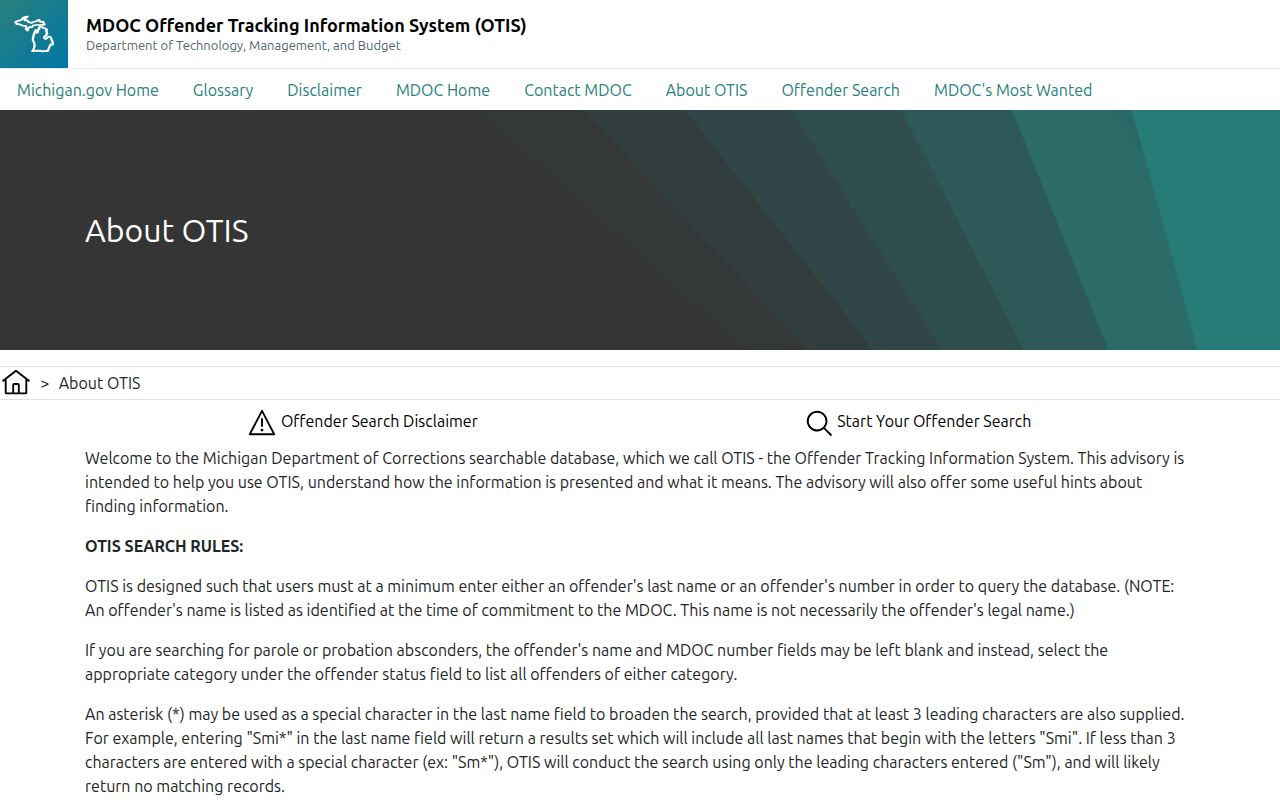
The OTIS definitions show why the eligibility, maximum, parole, supervision, and discharge fields must remain separate in any Montcalm County date check.
Michigan Minimum Is 100 Percent
Michigan’s current truth-in-sentencing framework is not an 85% rule. For specified assaultive crimes committed on or after December 15, 1998, and other covered crimes committed on or after December 15, 2000, MDOC states that the prisoner must serve 100% of the judicial minimum before parole consideration. Good-time and disciplinary credits do not shorten that minimum. Disciplinary time is used instead and may affect the calculation and the Board’s review. This is the distinctive point in a Montcalm County projected release date calculation. The Earliest Release Date is the Board eligibility point, not a guarantee or an appointment to leave Carson City Correctional Facility.
MCL 791.234 governs Parole Board jurisdiction and eligibility. It also has special rules and exclusions for life sentences. Some life offenses, including first-degree murder under MCL 750.316, are nonparolable. Other parolable life cases use rules tied to the offense date and statutory exceptions, so no broad percentage can replace a case-specific MDOC calculation.
The MDOC truth-in-sentencing explanation states the 100%-of-minimum rule.
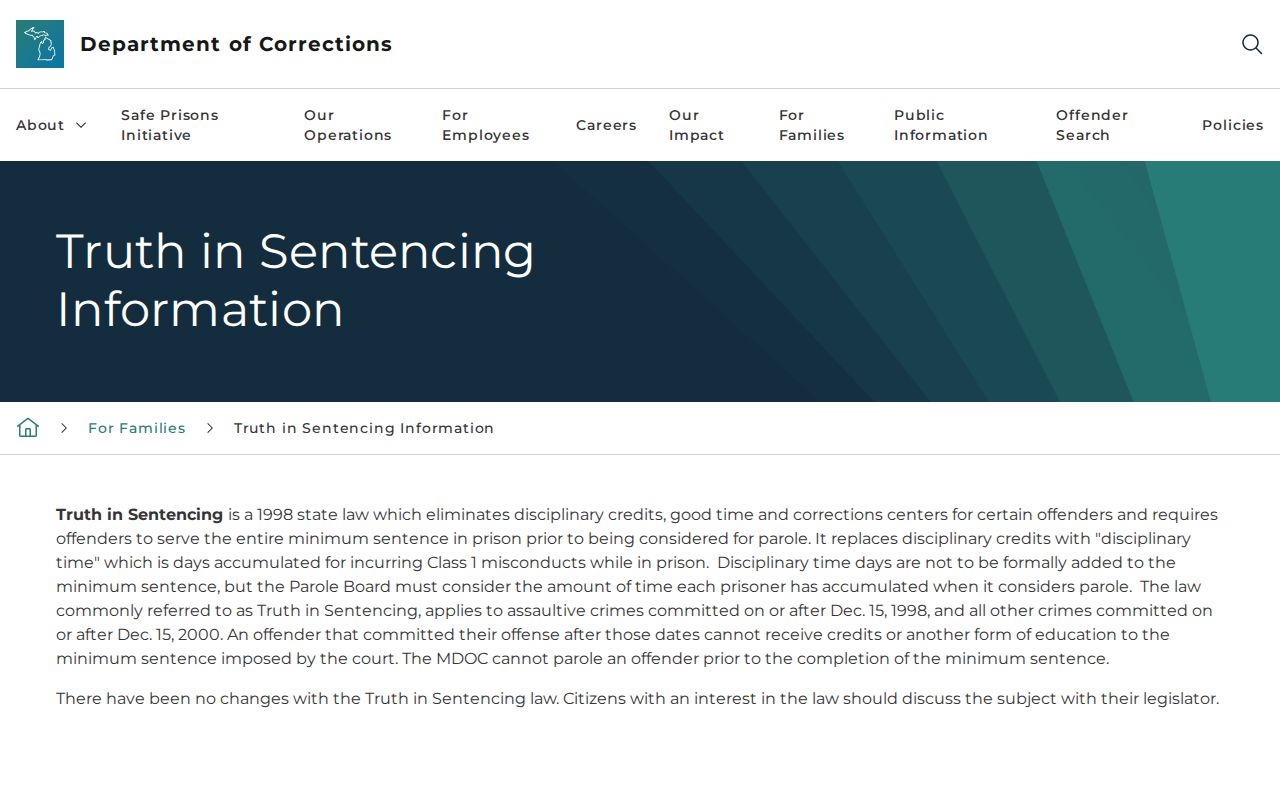
The official page is the source for the percentage rule and prevents an inaccurate 85% estimate from being attached to a Michigan sentence.
Older Montcalm Release Credit Rules
Older offense dates can produce a different credit framework. Eligible offenses committed before April 1, 1987 may earn good time at escalating monthly rates, commonly five through fifteen days per month, plus possible exemplary credit. For eligible offenses after that cutoff but before truth in sentencing, disciplinary credits generally total five days per month plus two exemplary days. Major misconduct can eliminate a monthly credit and lead to forfeiture.
These are not universal discounts. MCL 800.33 through 800.35 and MDOC disciplinary-credit policy determine whether good time, disciplinary credits, disciplinary time, restoration, or forfeiture applies. The offense date, sentence structure, misconduct history, and consecutive terms all matter. A percentage picked from another state or from a different Michigan sentence class will produce a false projected date.
- Judicial minimum
- The minimum prison term imposed by the court before parole eligibility under the applicable law.
- Good time
- A legacy credit system for qualifying older offenses, governed by offense date and statute.
- Disciplinary credit
- An older-sentence credit that can be affected by misconduct and forfeiture rules.
- Disciplinary time
- Time used under truth in sentencing that can delay the effective eligibility calculation.
- Parole
- Release from prison into the community while MDOC supervision and conditions continue.
Note: Ask MDOC for the maintained time computation when an older offense or mixed sentence makes the public date hard to interpret.
What Changes Montcalm Release Dates
An Earliest Release Date can move, or release may not occur at eligibility. The controlling record can change through discipline, court action, sentence aggregation, or a decision by the Parole Board. Even an unchanged date does not overcome a new hold that sends the person to another custodian instead of the community.
| Cause | Possible effect on release |
|---|---|
| Major misconduct or disciplinary time | May delay eligibility or affect Board assessment under the rules that apply. |
| Credit grant, loss, restoration, or forfeiture | Can change an older-sentence eligibility or maximum calculation. |
| Amended judgment or resentencing | May change the minimum, maximum, or credited jail time. |
| Consecutive sentence | Extends the combined term before release is possible. |
| Parole denial or deferment | No release occurs at eligibility; another review point is set. |
| Warrant, detainer, or new case | May stop community release or cause a transfer to another authority. |
| Parole grant suspended | The person stays in prison while the new information is reviewed. |
A detainer is a request or legal notice that another authority may take custody. It is why departure from Montcalm County Jail or an MDOC prison may lead to transfer rather than freedom. After prison release, a parole violation can also produce revocation and a return to custody. Always pair the date with the latest current status.
Montcalm Work Release Is Custody
Montcalm County work release creates a local custody-status trap. An approved inmate may physically leave for work, but that trip is not a release or discharge from the sentence. The sentence order, work-release application, coordinator approval, delay rules, and prepaid room-and-board requirements still keep the person legally incarcerated.
The Montcalm County Work Release Information documents the approval route and custody terms. Count the person as released only when the jail records an actual release event. A daily departure for approved work should never be substituted for the projected end of the jail sentence.
The official county requirements are visible in the work-release source.
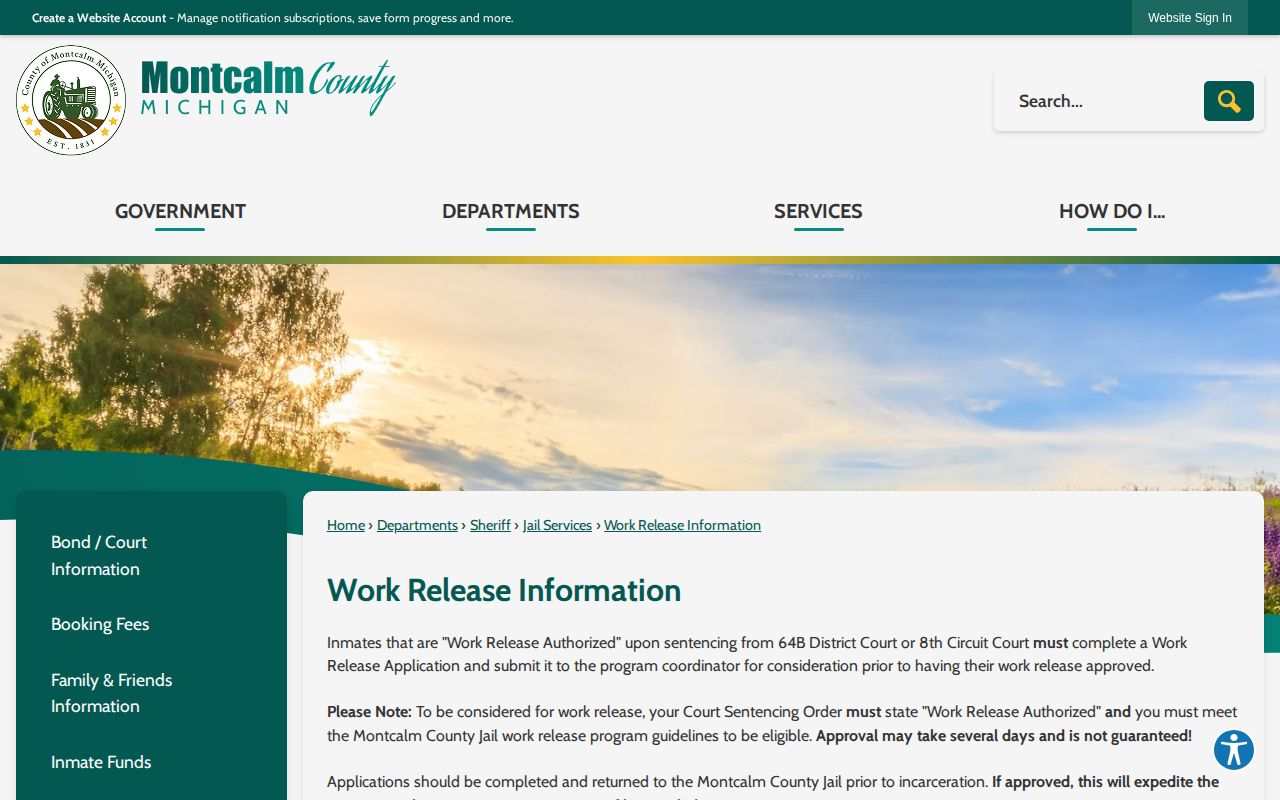
The authorization details show why time outside the building for approved work does not establish release from Montcalm County custody.
Montcalm Jail and Court Records
For a Montcalm County Jail sentence, use the court that entered the judgment and the jail record that applies it. The 64B District Court handles misdemeanor matters and preliminary felony proceedings. The 8th Judicial Circuit Court is the local source for felony case history. A judgment, amended order, or register of actions may explain the legal term, but it does not by itself prove the exact time of physical release.
Ask the county for the existing booking and release record when the jail’s timestamp or release disposition is needed. Identify the person by full name and date of birth, include the booking number if known, and use a narrow date range. Request a maintained release date and time, disposition, releasing facility, and any disclosable authorization or court order. Michigan FOIA covers existing public records; it does not require the county to create a new calculation or answer an open-ended question.
Pretrial custody must be treated with care. There is no sentence-completion date before judgment. Bond may allow release, yet payment alone does not prove that processing ended or that no hold remains. The jail and court answer related but different parts of the question.
Confirm a Montcalm Release Date
For an MDOC prisoner, return to OTIS near the projected point and read Current Status. Date Paroled confirms an actual departure to parole. Discharge Date confirms the end of MDOC jurisdiction for the displayed sentence. If the public fields conflict with the sentencing record, contact the court for court-derived errors or the assigned MDOC office for supervision and status corrections.
For Montcalm County Jail, call the jail status line and request the formal release record when a durable date matters. A VINE alert can provide a fast event signal, and the Montcalm County VINELink check explains registration and the phone PIN process. Confirm the alert with the reporting agency because data may lag and transfers can look like the end of one custodian’s record.
Note: Keep eligibility, physical release, start of parole, end of supervision, and final discharge as five separate events.