
Montcalm Parole Versus Probation
Parole is a conditional release from state prison. The Michigan Parole Board grants it, and the person remains within Michigan Department of Corrections jurisdiction while living in the community. Probation is a sentence imposed by a court. It may replace incarceration or follow a local jail term. Montcalm County adds an important local split: MDOC agents supervise parolees, adult felony probationers, and high-court-misdemeanor probationers, while the 64B District Court Probation Department handles misdemeanor probation.
The sentence source tells a reader where to verify the status. A Carson City Correctional Facility release to parole belongs in MDOC records. A misdemeanor probation order belongs in the 64B District Court case. The county jail release record can document when physical custody ended, but it does not by itself prove whether supervision followed.
| Status | Authority | Best public check |
|---|---|---|
| Parole | Michigan Parole Board after prison | OTIS Parolee status, Date Paroled, and Assigned Location |
| Felony or high-court-misdemeanor probation | 8th Circuit Court, supervised by MDOC | OTIS, circuit case, and Montcalm MDOC office |
| Misdemeanor probation | 64B District Court | District court case and 64B Probation Department |
| Final MDOC discharge | End of MDOC sentence or supervision authority | OTIS Discharged status and Discharge Date |
- Parole
- Community supervision after release from a state prison sentence.
- Probation
- Court-ordered supervision that may be imposed instead of prison or after a local term.
- Discharge
- The formal end of the agency's authority over the displayed sentence or supervision term.
- Absconder
- A person alleged to have stopped required supervision contact while still under jurisdiction.
Verify Montcalm Post-Release Supervision
The public starting point for MDOC supervision is the Offender Tracking Information System, known as OTIS. Its status menu includes Parolees, Probationers, Parole Absconders, Probation Absconders, and Discharged. A unique MDOC number is the strongest search key. If it is not known, use the last name with first name, age, or other identifiers to reduce a false match.
- Decide whether the case involves prison parole, felony probation, high-court-misdemeanor probation, or misdemeanor probation.
- For an MDOC case, search OTIS by MDOC number or name and compare identifying details before opening a record.
- Read Current Status, Date Paroled, Assigned Location, and Supervision Discharge Date together. One field alone may give an incomplete picture.
- For a misdemeanor, search the 64B District Court case and contact its probation office for the court-supervised status.
- When a formal end-of-supervision record is needed, request the discharge order or agency certificate from the responsible court or MDOC.
The official search form shows how finely Michigan separates supervision states. The OTIS search source can be checked before a call to the assigned office.
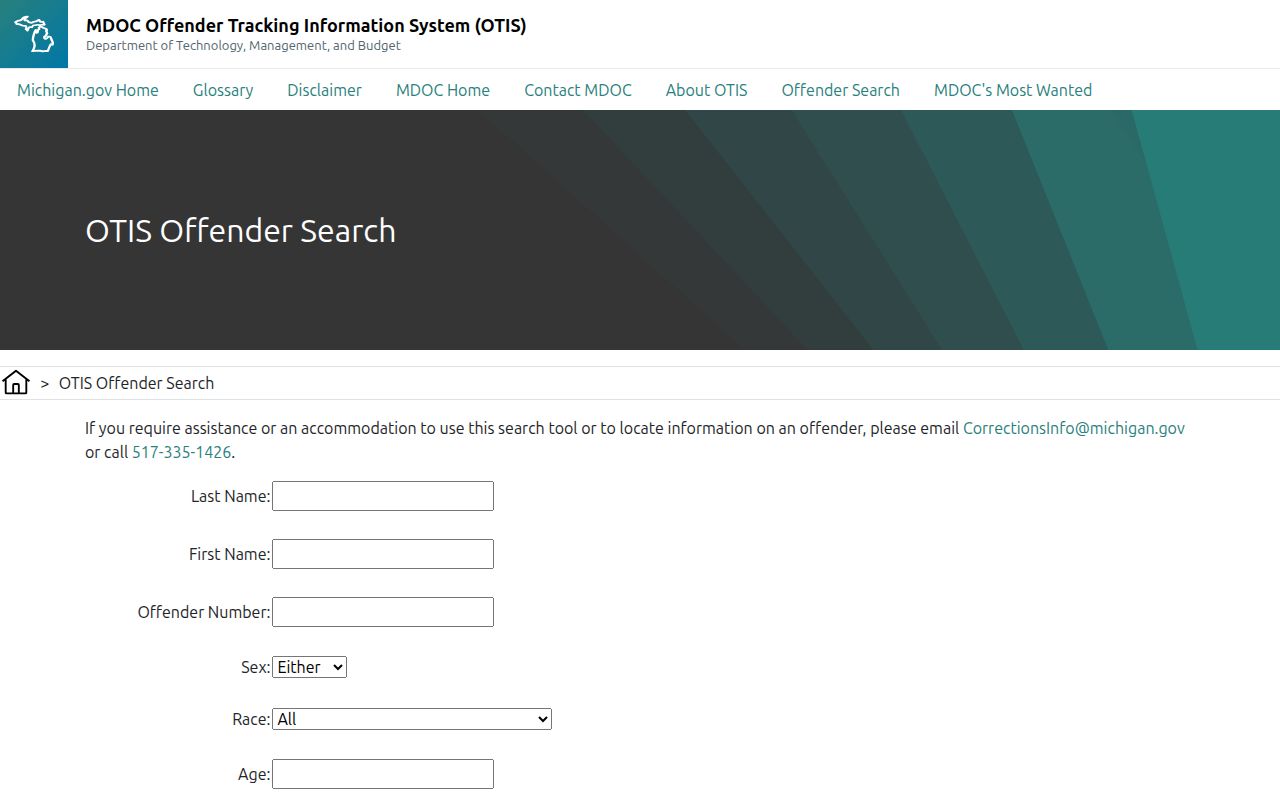
The status choices in the image help distinguish lawful discharge from active parole, active probation, or an absconder entry.
OTIS does not cover every local case. A county-jail-only booking may never enter MDOC jurisdiction, and a 64B misdemeanor probation file can remain a court matter rather than an OTIS record. The local case type must guide the lookup.
Note: OTIS tracks MDOC jurisdiction, not every county-jail booking or every misdemeanor probation case in Montcalm County.
Montcalm MDOC Supervision Office
Montcalm's state supervision work is assigned through MDOC Field Operations Administration. Local agents prepare presentence reports and supervise parolees plus adult felony and high-court-misdemeanor probationers. The office can address an assigned-location question or a suspected supervision-record error after the public OTIS record has been checked. It is not a replacement for the OTIS name search.
Montcalm County Parole/Probation Office
627 N State Street
Stanton, MI 48888
989-831-7353
MDOC Region 4b
The MDOC Region 4 directory identifies the Montcalm office and its placement in the state system. It is the correct local channel for parole and MDOC-managed probation. A release from Carson City Correctional Facility may place a person under an office elsewhere, however, so the Assigned Location field should control.
The official directory view shows Montcalm among Region 4 offices. Check the source listing for current agency contact details.
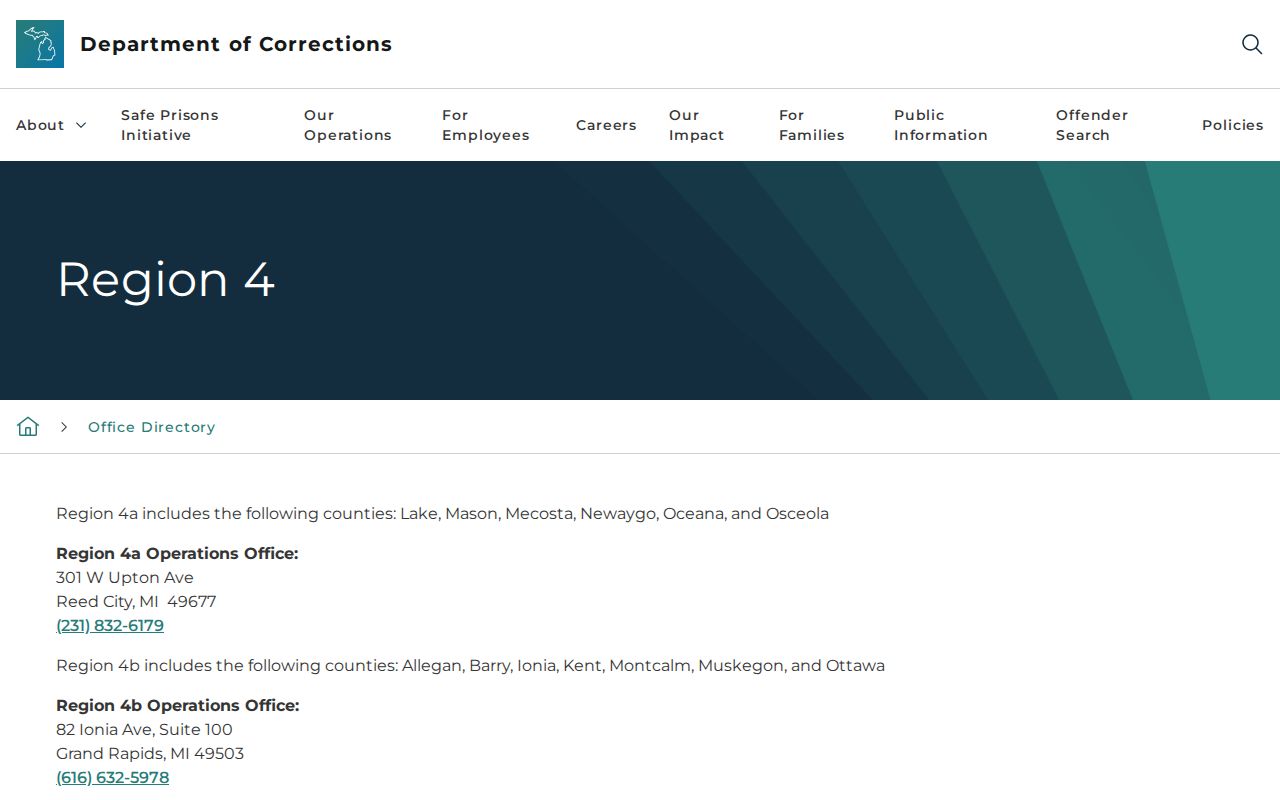
The local entry anchors a supervision inquiry to the responsible state office rather than to the county jail.
Montcalm Probation's Local Split
A misdemeanor case does not follow the same contact path as state parole. The 64B District Court Probation Department handles misdemeanor probation at 617 N State Street in Stanton. Its listed telephone is 989-831-7434, and its email is probation@montcalmcountymi.gov. Court case entries can show the sentence, later probation activity, and an order that ends supervision.
By contrast, the Circuit Court Probation/Parole page explains that local MDOC staff supervise adult felony and high-court-misdemeanor cases as well as parolees. The 8th Circuit case is the court-record route for a felony sentence. This local division matters because a call to the wrong office may produce no answer even though the person remains supervised.
64B District Court Probation
617 N State Street
Stanton, MI 48888
989-831-7434
probation@montcalmcountymi.gov
The supervision split is also a records split. MDOC records close state jurisdiction, while a district court order closes a misdemeanor probation case. Neither record alone establishes the exact hour when the jail processed a physical departure.
Note: A court sentence may establish supervision but cannot certify the Montcalm County Jail's exact physical release time.
Montcalm Supervision and Absconders
Conditions of supervision can include reporting, travel limits, treatment, or other terms set by the Board, court, and supervising agency. An alleged violation does not mean supervision has ended. It can prompt agency review, a court response, or custody action. Current status should come from the responsible agency and case record.
OTIS uses ABSCOND1 for a parole absconder actively sought by MDOC. ABSCOND2 describes a probation absconder who remains under the sentencing county's jurisdiction. Neither label means discharge. OTIS also permits a status-only search, which can help when checking the public absconder categories. The MDOC contact page lists the Absconder/Escapee Tip Line at 517-755-0855.
An absconder entry indicates an alleged loss of required contact while jurisdiction continues. It is not proof of lawful completion.
MI-VINE can report certain custody changes, but it does not replace OTIS or the court file for supervision status. If an absconder record appears wrong, route the issue to the assigned parole/probation office shown in OTIS. Court-derived errors must be corrected through the sentencing court.
A supervision violation and an absconder label also answer different questions. A violation is an alleged breach of one or more conditions. Absconder status concerns a loss of required contact while legal authority continues. Either can lead to further review or custody, but neither is the same as a final court finding. Read the public status as an agency record and seek the related court or MDOC document when the outcome must be established.
Montcalm Parole Board Channels
The Michigan Parole Board is the state's sole paroling authority. Most decisions are made by three-member panels, while a majority of the ten-member Board decides lifer matters. Eligibility opens review. It does not promise release. Under MCL 791.234, the sentence, offense date, and legally applicable credits control when Board jurisdiction begins.
The public hearing registration page is a rolling list for scheduled public lifer and clemency hearings. It is not a calendar of every routine parole interview. Hearing notices are generally posted from about two weeks to thirty days before the event, and registration closes two business days before. The page bars recordings, photographs, and screenshots of actual proceedings.
The official hearing page displays the rolling schedule and registration links. Use the MDOC hearing source for current entries.
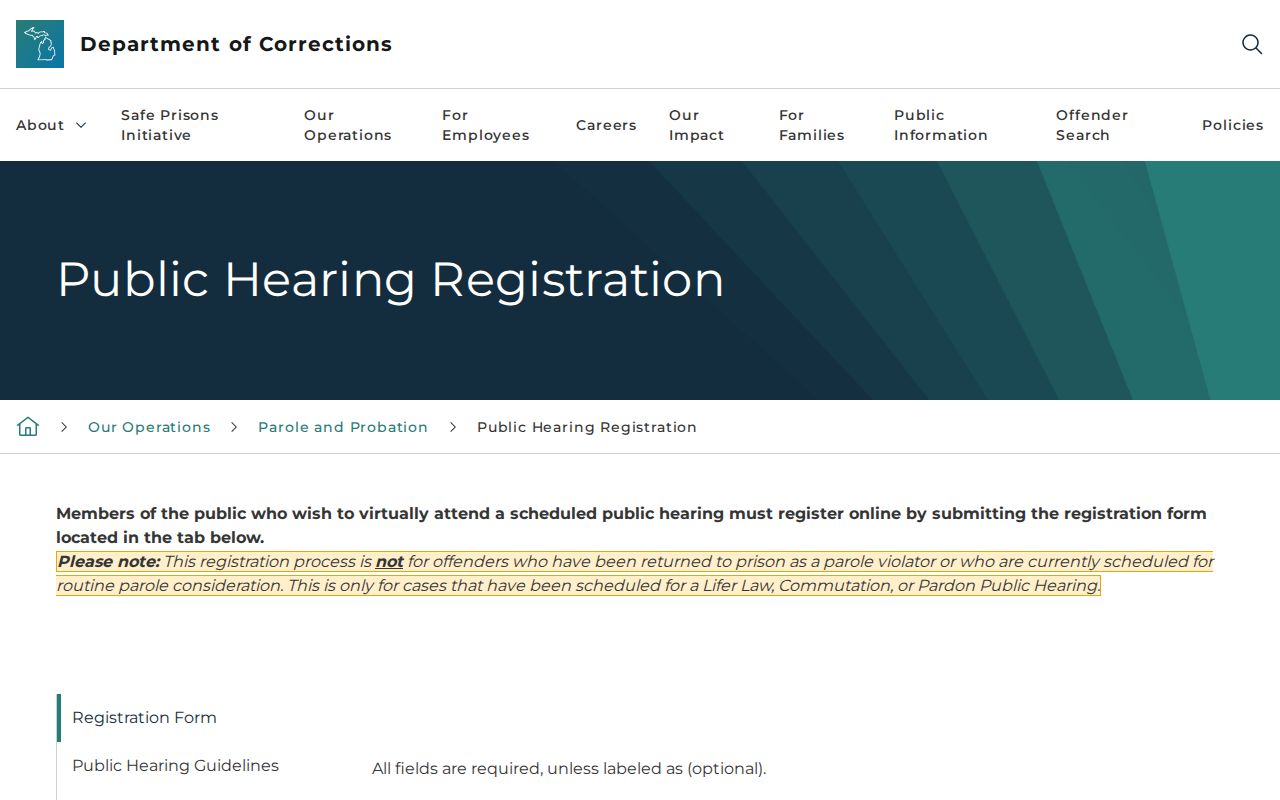
The schedule image illustrates the Board's public-hearing channel without implying that all Montcalm parole decisions appear there.
Board consideration can include the offense, prior record, conduct while incarcerated, completed programming, age, the parole-guideline score, risk instruments, the interview, and information properly submitted to the Board. These are review factors, not a public formula that lets a reader predict a release. A person can reach the Earliest Release Date and still receive a denial or deferment because eligibility only opens the Board's authority to act.
Michigan does not provide a separate public person-by-person decision portal beyond OTIS. Quarterly decision reports give aggregate granted, denied, and deferred totals, not an individual's result. For one person, read OTIS after the agency updates Date Paroled or status. A Notice of Decision may require Board contact or an MDOC FOIA request. The Board lists 517-373-0270 and Parole-Board-Staff@michigan.gov.
The supported public outcome terms are granted, denied, and deferred. A denial sets another review date under the applicable process. A grant is still not proof of physical departure. MDOC can suspend the grant before release if new misconduct or adverse information arises. After actual departure, a later violation may produce revocation. OTIS Date Paroled is the key public field for the completed move from prison to community parole.
Montcalm Supervision Discharge Records
Supervision ends through a formal discharge, not merely because an expected date has passed. OTIS can display a Supervision Discharge Date, but that field must be read with Current Status and the sentence record. A Discharged status and Discharge Date indicate that MDOC jurisdiction ended for the relevant record. A court order may instead close a 64B probation term.
A durable confirmation comes from the agency that had authority. Request the discharge order from the court or the discharge certificate and related record from MDOC. OTIS records may be removed three years after discharge, and a later supervision term can restart that period. Set-aside matters are removed when law or court order requires, so an empty result is not conclusive proof that no prior supervision existed.
The county-jail release and court history may still matter. The full Montcalm County released-inmate lookup explains how jail, court, VINE, and corrections records fit together when physical release and supervision are separate events.
Note: Date Paroled proves departure from prison to parole; Discharge Date marks the later end of MDOC authority for the record.